

A woman holds up her sheet of paper and chuckles nervously, “Sorry, I can’t draw.” The other folks around the meeting table grin and chuckle as well in a camaraderie fashion.
My inner creativity coach winces.
I’m participating in one of those icebreaker activities at a work function. The activity involves some drawing of abstract concepts, and I’m noting that virtually every person around the table begins the sharing of their work with some variation of “I can’t draw.”
No one is being cruel or mocking their drawing efforts, either. It’s more like these people want you to understand that they know they can’t draw, so we, the audience, aren’t judging them for it.
But think about that for a moment…
Have you ever joined in with singing “Happy Birthday” to a friend and felt the need to declare to everyone around you that you aren’t a good singer?
Have you ever cooked for friends and family and, before setting the meal down, warned folks that you aren’t a good cook?
Have you ever gone out clubbing and announced to every person who wanted to dance with you that you’re a terrible dancer?
Perhaps you are, in fact, that self deprecating. I’m betting, however, that you didn’t feel the same compulsion because we understand that those who casually sing, cook, or dance aren’t likely to be as skilled as a seasoned professional.
So, why is it we fear judgment about our art-making abilities? I believe it’s because so many adults are nursing art scars.
What is an art scar?
I first encountered the concept of an art scar in Julia Cameron’s book, “The Artist's Way.” She describes them as artistic scar tissue that is the result of leftover emotional damage that has been caused by creative criticism, rejection, loss and/or shame.
From what I’ve seen in my work as a creativity coach, there is often a transition point in our childhood between when our art-making efforts are encouraged or, at the very least, allowed to flourish unimpeded and when those efforts start to be scrutinized more seriously.
A parent goes from putting every piece of artwork on the fridge to urging the child to stop wasting their time drawing and work on their academic homework
A teacher goes from giving her students free rein over their artwork to grading their artwork in accordance with the “right way” to do the exercise
A child goes from happily sharing their artwork with friends to being afraid of what those same friends will say if the lion they’ve drawn doesn’t look sufficiently like a lion
With persistence and emotional weight behind them, all of these could lead to lingering art scars in adults. I believe they are why so many adults default to statements like “I can’t draw” or “I’m not creative” when faced with any kind of art-making activity.
Sadly, art scars like these also prevent people from experiencing the enjoyment and benefits that can be derived from even a casual artistic practice.
The path to healing art scars
When we began crafting the CreativiTEA for Grown-ups workshops, I knew that the biggest obstacle we would have would be these lingering art scars. It felt important to address our participants’ unspoken fears head-on to ensure that folks would feel like they were making art in a safe environment.
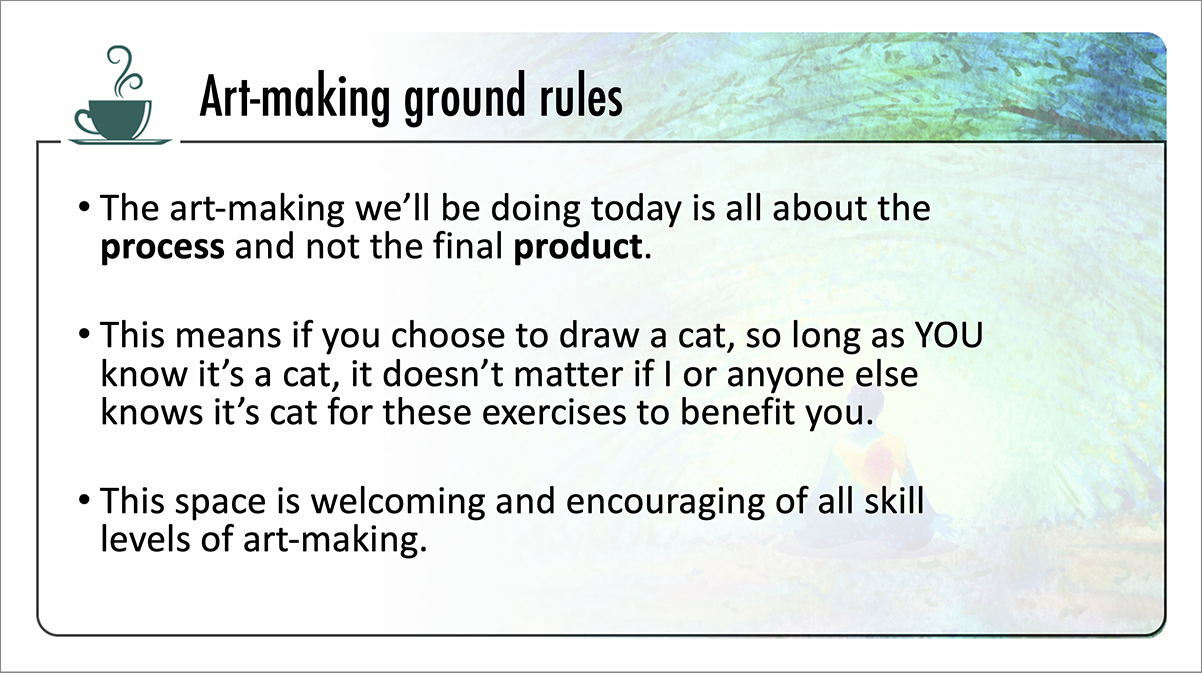
If you look at the slide above, you may recognize that these ground rules are, in essence, deliberately designed to reproduce the kind of art-making environment that we allow for children, but not for adults.
Kids create art for the sake of creating art. They are all about the process.
Kids aren’t obsessed with creating realism in their art. Cats, dogs, houses, people… so long as they know what they intended to draw, and that’s all that matters.
Kids are more than happy to be supportive and encouraging of the art-making of their peers—at least until they start absorbing lessons from the adults around them about what constitutes “good art” and “bad art.”
So, the next time you find yourself criticizing your own art-making efforts, take a moment to ask yourself why. Where is that criticism coming from? What purpose does it serve?
Are you saying “I can’t draw” because you’re unconsciously afraid that if you don’t, then someone else will?
Our next workshop is this coming Sunday
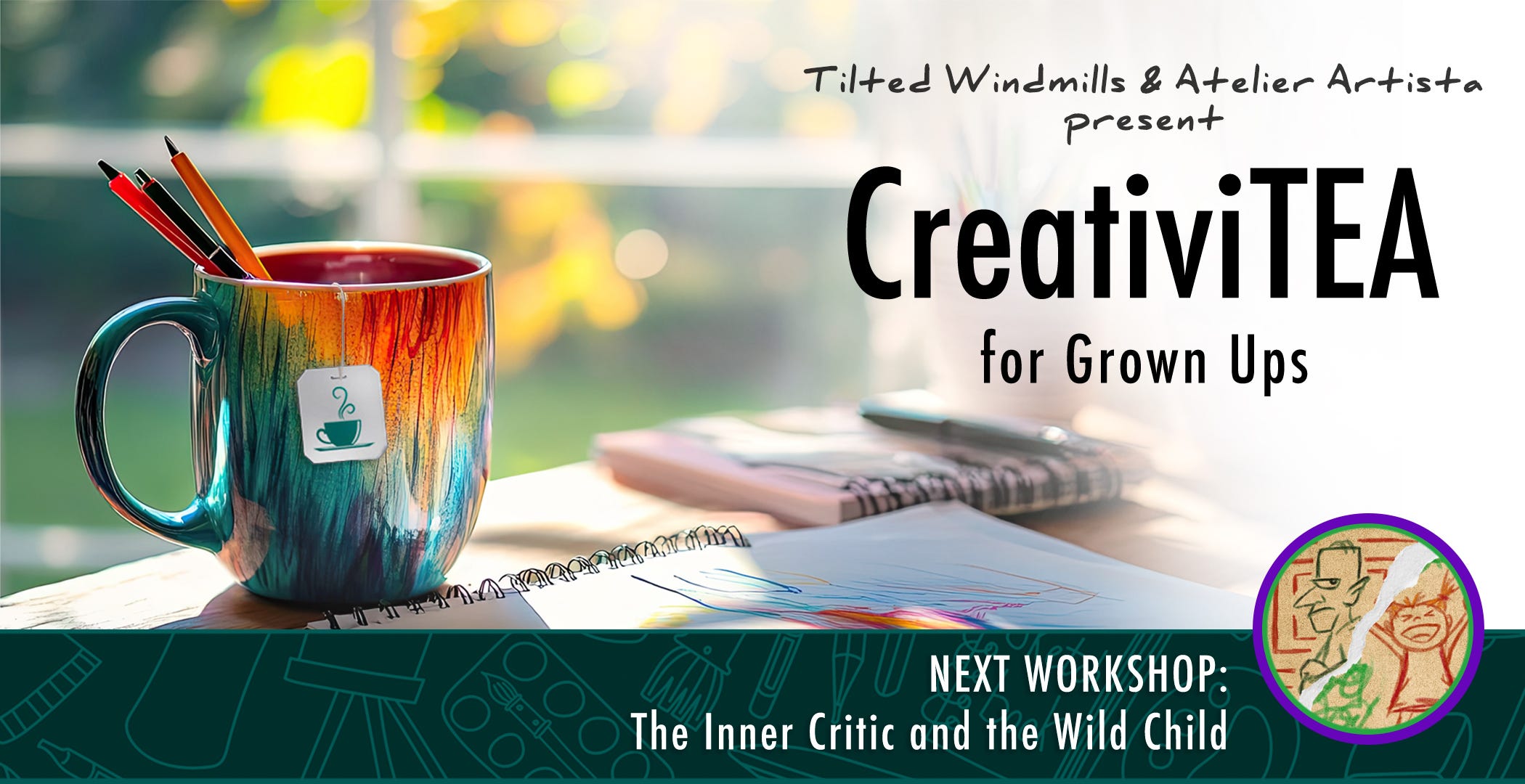
There are still a few tickets left for our upcoming workshop exploring the Inner Critic and the Wild Child. The workshop will be happening this Sunday, April 12th, from 1-3pm at Atelier Artista on the 4th floor of cSPACE Marda Loop.
Tickets are only $25 and include all art supplies, tea and delicious desserts.
Hope to see you there!
Athena Cooper splits her time between being a fine art painter, writer and a creativity coach with Tilted Windmills.
Thanks Athena, for your insights, yet again. Its so true, I have caught myself doing that exact thing. I will have to be more aware of that in the future!
I haven't heard of the concept of "art scars" before! It was instantly recognizable to me (sadly) and I bet it will be for other too. My art scars consistently get in the way of my enjoyment of the creative process and I am actively trying to disrupt their influence. Having words that create a clear picture will help me keep and eye on their influence. Thanks for sharing!